
Ruth Bancroft Law: The Lynn-Born Aviator Who Took Flight Over Saugus
Why Rumney Marsh Conservancy Is Remembering Her
On May 21st, Rumney Marsh Conservancy is remembering Ruth Bancroft Law, later Ruth Law Oliver, one of the most accomplished American aviators of the early 20th century.
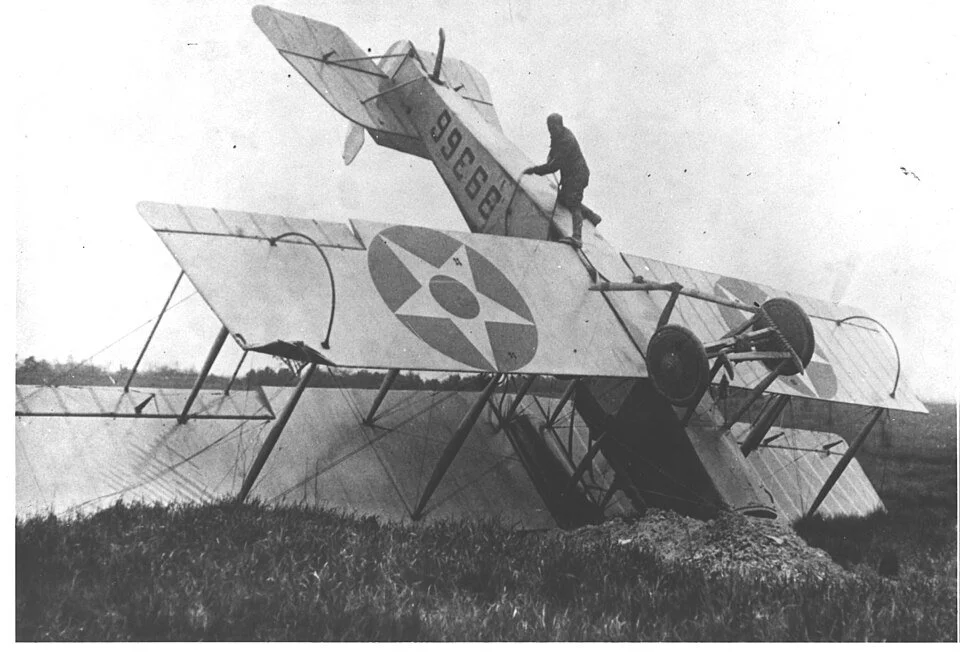
A wrecked Curtiss JN-4H "Jenny" airmail plane at Saugus Field. Army pilot Lt. Webb is visible climbing up the underbelly of his crashed plane.
At first glance, aviation history may seem like an unusual subject for a marsh conservancy. But Ruth Law’s story is also a local landscape story.
More than a century ago, Saugus was home to an early airfield in Rumney Marsh. Before Logan Airport, before modern runways, and before commercial aviation became part of daily life, early pilots were learning, testing, and demonstrating flight from open fields around Greater Boston. One of those places was Saugus Field, also known in connection with Harry Atwood and Atwood Park.
That field helped place Saugus and Lynn into the early history of American flight. Harry Atwood, one of the best-known aviators of his day, trained and taught pilots there. Ruth Bancroft Law, born in Lynn, entered that world in 1912. A contemporary clipping preserved in her scrapbook describes her piloting an airplane to 7,800 feet above Saugus, with instructor Arch Freeman aboard.
So yes, Ruth Law quite literally flew over this local landscape. The same broad region we now know through marshes, rivers, roads, neighborhoods, and industrial history was once part of the frontier of early aviation.
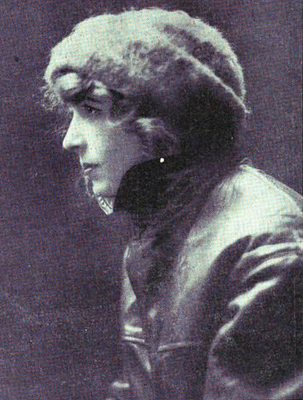
Ruth Law, from the cover of the May 5, 1917 issue of Billboard
A Lynn-Born Pioneer
Ruth Bancroft Law was born in Lynn, Massachusetts, in 1887. She grew up at a time when powered flight did not yet exist. The Wright brothers’ first successful flight took place in 1903, when Law was a teenager. Less than a decade later, she would become part of the first generation of Americans learning to fly.
Her brother, Frederic Rodman Law, was a well-known daredevil and stunt performer. Ruth had her own appetite for risk, but her path was not just performance. She wanted to master airplanes at a time when aviation was new, dangerous, and overwhelmingly male.
Early aircraft were fragile machines of wood, fabric, wire, and exposed engines. Flying meant cold, noise, vibration, mechanical uncertainty, and very little margin for error. For women, there was also a cultural barrier. Many people still saw aviation as no place for them.
Law entered anyway.
The Saugus Airfield and Harry Atwood’s Aviation World
The heart of Ruth Law’s local story is Saugus.
In the early 1910s, Saugus Field became one of the important aviation sites north of Boston. It was associated with Harry N. Atwood, a celebrated early aviator who had already gained national attention for long-distance flights. Atwood’s operation helped make Saugus a teaching and demonstration ground during the first years of American aviation.
This was before airports looked like airports. A flying field could be just that: a field. These were places where pilots learned to handle machines that were still being improved by trial, error, and nerve.
Law trained in this Saugus aviation environment. Later accounts often connect her training to Harry Atwood, while one of the strongest surviving local references names Arch Freeman as the instructor with her during a notable Saugus flight. Rather than reducing the story to one teacher, the better picture is this: Law learned within the early aviation community centered around Saugus Field, Atwood’s operation, and the instructors working there.
Ruth Law was not simply a famous aviator who happened to be born in Lynn. Her early flying career was tied to the North Shore.
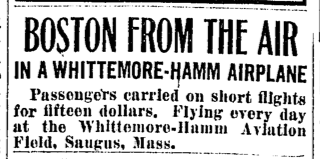
1919 Boston Globe advertisement for short flights at Saugus Field.
Flying Above Saugus
One clipping from Law’s own scrapbook gives the local connection unusual clarity. It reports that “Miss Ruth Law” steered an aeroplane up 7,800 feet above Saugus, with Arch Freeman aboard as her instructor.
For 1912, that was an extraordinary thing to see and read about. A Lynn-born woman was not only learning to fly, but doing so above a community that sat beside the marshes, rivers, and open land north of Boston.
The Rumney Marsh area was already a working, changing landscape. Rail lines, roads, farms, tidal creeks, and industrial activity were all part of the region’s story. Then, briefly and remarkably, the skies above it became part of another story: the beginning of modern aviation.
From Local Student to National Record-Setter
Ruth Law’s career soon moved far beyond Massachusetts.
She became known across the country for her endurance and skill. In 1913, she became the first known woman to fly at night. In 1915, she performed public looping exhibitions. In 1916, she made her most famous flight, traveling from Chicago toward New York in a modified Curtiss pusher aircraft.
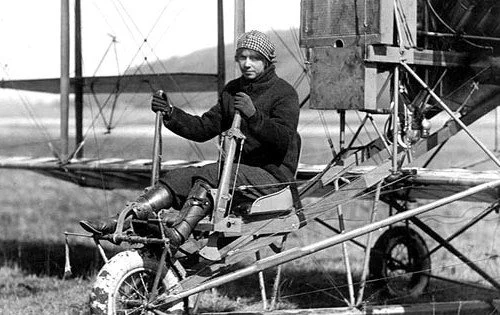
Ruth Law in 1915: Her aircraft is a Curtiss Pusher, but has Wright Brothers control levers.
That 1916 flight brought her national attention. She set major distance records and became one of the best-known aviators in America.
Her aircraft was open to the air, with limited protection from the cold. She expanded its fuel capacity and adapted it for longer-distance travel. These were not polished, comfortable flights. They were physically demanding, technically difficult, and dependent on a pilot’s judgment.
Law became famous because she kept doing things people did not expect her to do.
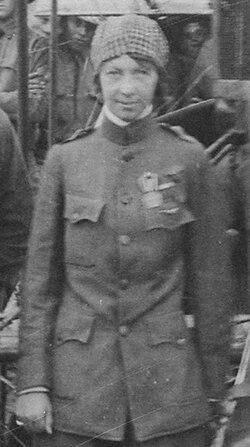
Ruth Law was the only woman in World War I permitted to wear the French government aviation uniform for nonmilitary purposes.
Wartime Service and Public Recognition
During World War I, Law wanted to serve as a military pilot. Women were not allowed to serve in that role, but she still used aviation in public service. She flew in support of Liberty Loan and Red Cross campaigns and became the first woman authorized to wear an Army aviation uniform.
After the war, she organized Ruth Law’s Flying Circus, a three-plane exhibition group that performed at public events. In 1919, she carried the first official air mail to the Philippine Islands.
Her career touched many places, but the New England foundation remained important. Lynn was her birthplace. Saugus was part of her training ground. The North Shore helped launch a woman whose career would become national news.
“The surest way to make me do a thing is to tell me I can’t do it.”
Returning to Lynn
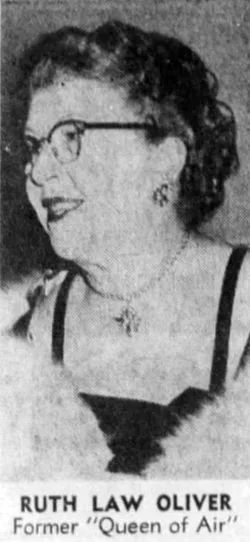
Ruth Law eventually retired from aviation and lived a quieter later life. She died in San Francisco on December 1, 1970. She was buried in Pine Grove Cemetery in Lynn.
That gives her life a local arc. She was born in Lynn, learned to fly in the aviation world of nearby Saugus, rose to national prominence, and was ultimately returned to the city where her story began.
A Local History Worth Remembering
Rumney Marsh Conservancy’s work is centered on the marsh: its ecology, history, restoration, and public value. But places are made of many overlapping stories. Natural history, community history, transportation history, industrial history, and personal stories all share the same landscape.
Ruth Bancroft Law’s story is one of those layers.
She reminds us that the Rumney Marsh region has never been just one thing. It has been tidal marsh and working waterfront, farmland and transportation corridor, neighborhood edge and open space. For a brief but important period, it was also part of the early aviation world.
On the anniversary of Ruth Law’s birth, we are glad to remember a remarkable Lynn-born woman whose achievements reached far beyond New England, but whose first chapters were written right here.
Sources and Further Reading
This post was prepared using a mix of archival, museum, municipal, and aviation-history sources. A few details in Ruth Law’s biography vary across sources, including her exact birth date and some early training dates, so we’ve relied most heavily on Smithsonian and archival materials where available.
Primary and archival sources
National Air and Space Museum Archives, Ruth Law Collection. A central archival collection containing Ruth Law’s scrapbook, photographs, newspaper clippings, correspondence, programs, and related aviation materials. https://airandspace.si.edu/collection-archive/ruth-law-collection/sova-nasm-xxxx-0387
Smithsonian Transcription Center, Ruth Law scrapbook material. Includes a transcribed clipping titled “Miss Ruth Law Steers Aeroplane Up 7800 Feet,” documenting her 1912 flight above Saugus with instructor Arch Freeman aboard. https://transcription.si.edu/view/26060/EIGa7
Claudia M. Oakes, United States Women in Aviation Through World War I, Smithsonian Institution Press, 1978. A key Smithsonian publication on early women aviators, including Ruth Law’s training, aircraft, exhibitions, records, and wartime work. https://repository.si.edu/bitstream/handle/10088/2668/SSAS-0002_Lo_res.pdf
National Air and Space Museum, “Ruth Law: Record-Setting Early Aviator”. A concise Smithsonian overview of Law’s aviation career and major accomplishments. https://airandspace.si.edu/stories/editorial/ruth-law-record-setting-early-aviator
National Postal Museum, “Ruth Law”. Details Law’s role in early air mail history, including her carriage of the first official air mail to the Philippine Islands. https://postalmuseum.si.edu/exhibition/fad-to-fundamental-airmail-in-america-airmail-pilot-stories-mail-by-female/ruth-law
Local and regional sources
Saugus Public Library / Digital Heritage. Local-history materials related to Saugus, Atwood Park, and early aviation activity, including references to Harry Atwood and early air mail between Saugus and Lynn. https://digitalheritage.noblenet.org/s/saugus/item?page=8&sort_order=desc
City of Lynn, Pine Grove Cemetery. Municipal cemetery information connected to Ruth Law Oliver’s burial in Lynn. https://www.lynnma.gov/city_government/departments/dpw/pine_grove_cemetery
Images and additional reference material
Library of Congress, “Ruth Law at Gov’s Island”. Historic image record connected to Law’s 1916 record-setting flight. https://www.loc.gov/pictures/item/2014703189/
Library of Congress, “Ruth Law, the daring woman flyer” Historic image record of Ruth Law. https://www.loc.gov/pictures/item/2002721726/
The Museum of Flight Archives, Ruth Law biographical materials. Supplemental archival and photographic material related to Ruth Law and early aviation. https://archives.museumofflight.org/agents/people/3774
