
Rumney Marsh Has a Hydrology Problem
There is increasing interest in marsh restoration and coastal resilience projects, including at Rumney Marsh. A number of proven, low-impact techniques are being discussed and applied in salt marsh systems across the region.
These include techniques such as ditch remediation, runneling, and targeted vegetation management. Each is designed to address common symptoms of marsh degradation, particularly poor drainage, stagnant water, and vegetation shifts that follow.
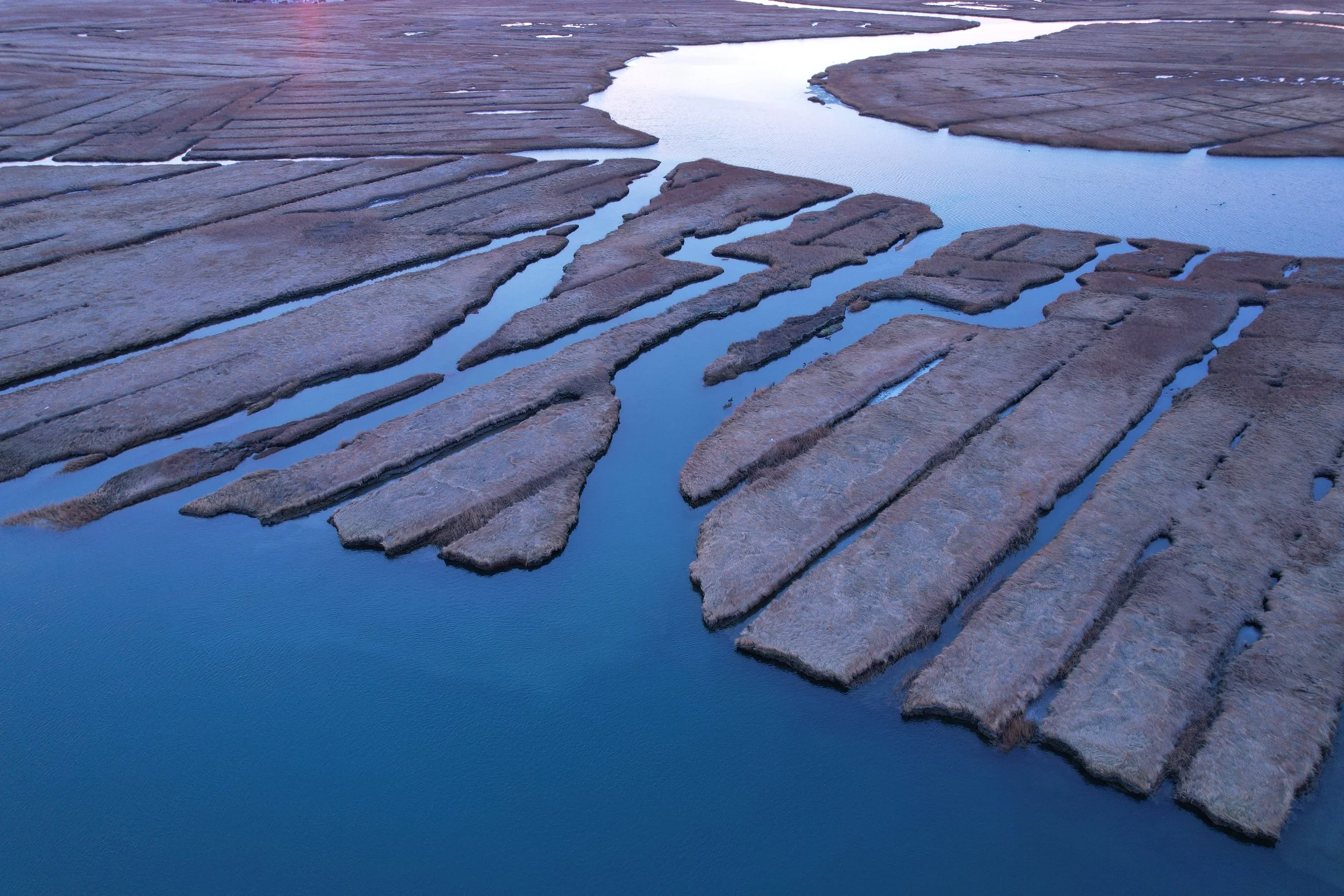
Historic mosquito ditches in Rumney Marsh, cut a century ago, have widened and eroded to the point where restoration is no longer straightforward.
Ditch remediation focuses on the network of straight-line mosquito ditches that were historically cut through the marsh. Over time, many of these ditches have become over-widened, eroded, or disconnected from the surrounding marsh surface. Techniques like mow and rake remove accumulated debris and invasive growth, while fill or plug methods partially close sections of ditch to restore more natural water retention and sheet flow across the marsh platform. The goal is not to eliminate drainage entirely, but to rebalance it so the marsh holds and releases water more like an intact system.
Runneling takes a more surgical approach. Shallow, narrow channels are cut across the marsh surface to help standing water drain off the platform and reconnect to existing tidal creeks. These runnels are typically small enough to minimize disturbance but effective at relieving chronic pooling, which can otherwise lead to vegetation loss and peat collapse. They are often used in areas where the marsh has become waterlogged and cannot drain on its own.
Targeted vegetation management addresses the plant side of the system, particularly the expansion of species like phragmites in response to altered hydrology. This can involve selective cutting or other methods to reduce dominance and allow native salt marsh species to reestablish. In many cases, the goal is not just removal, but creating the conditions where native vegetation can compete again.
These approaches are relatively low-cost, minimally invasive, and in the right conditions, effective. They can improve drainage, reduce stagnant water, and help shift vegetation toward more desirable conditions.
They have a role at Rumney Marsh, but they are not the limiting factor.
Hydrologic Constraints at Rumney Marsh
Rumney Marsh is operating under a major hydrologic constraint: the abandoned I-95 embankment. This feature alters tidal flow across the system. It affects how water moves in and out, how long it stays, and how evenly it is distributed.
Salt marshes are driven by hydrology. When tidal exchange is functioning properly, many aspects of the system regulate themselves. When it is not, issues that appear at the surface, poor drainage, vegetation shifts, and erosion, are often symptoms of that disruption.
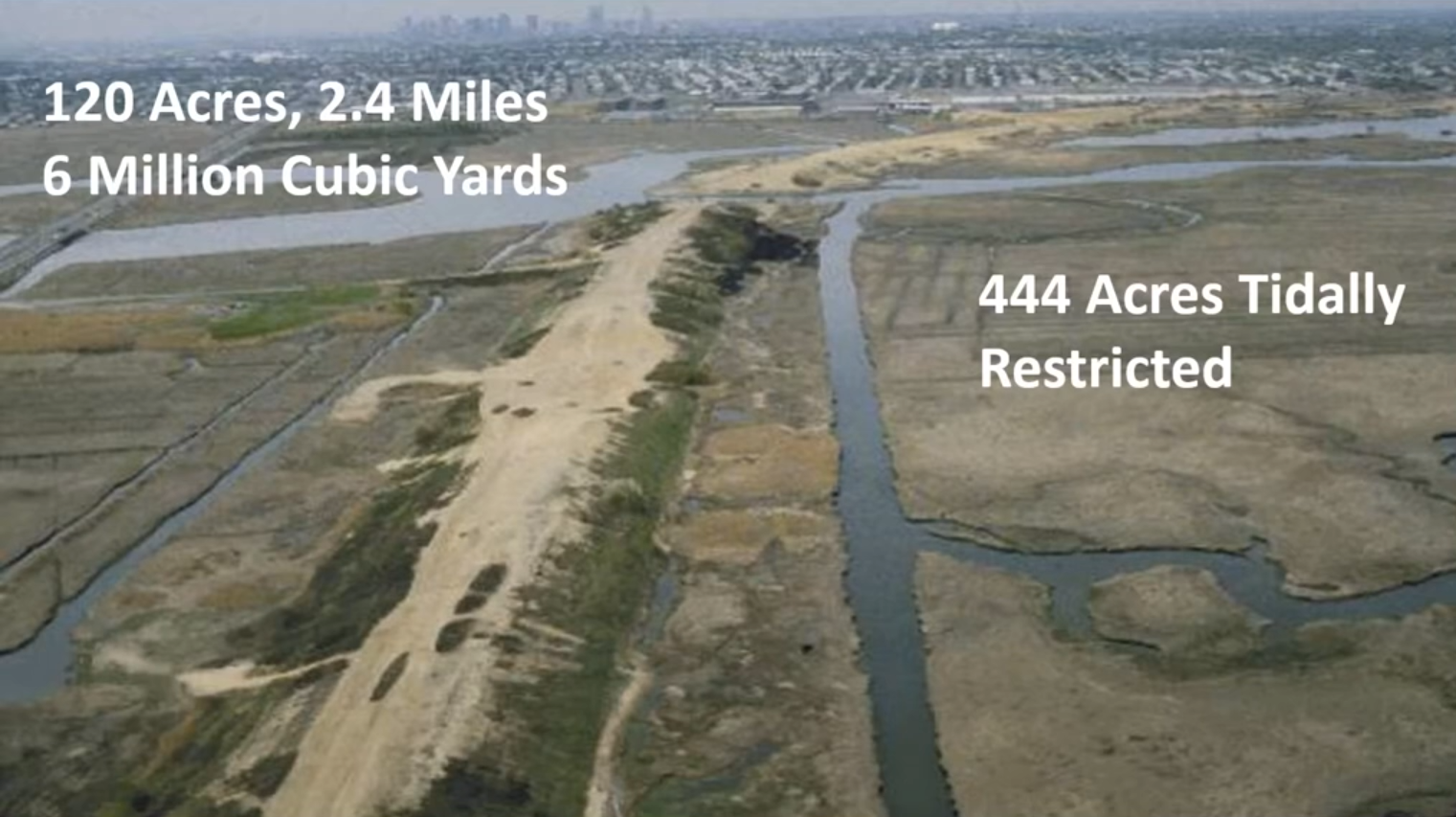
This is the core constraint.
Low-impact restoration techniques can improve conditions locally, but they operate within the constraints of the existing system. If tidal flow remains restricted or uneven, those improvements are inherently limited. In some cases, they may not persist.
At a certain point, the work risks becoming incremental improvement inside a system that cannot fully respond.
The embankment is the system-level control, like a partially closed valve in a pipe.
A Ditch That Became a Channel
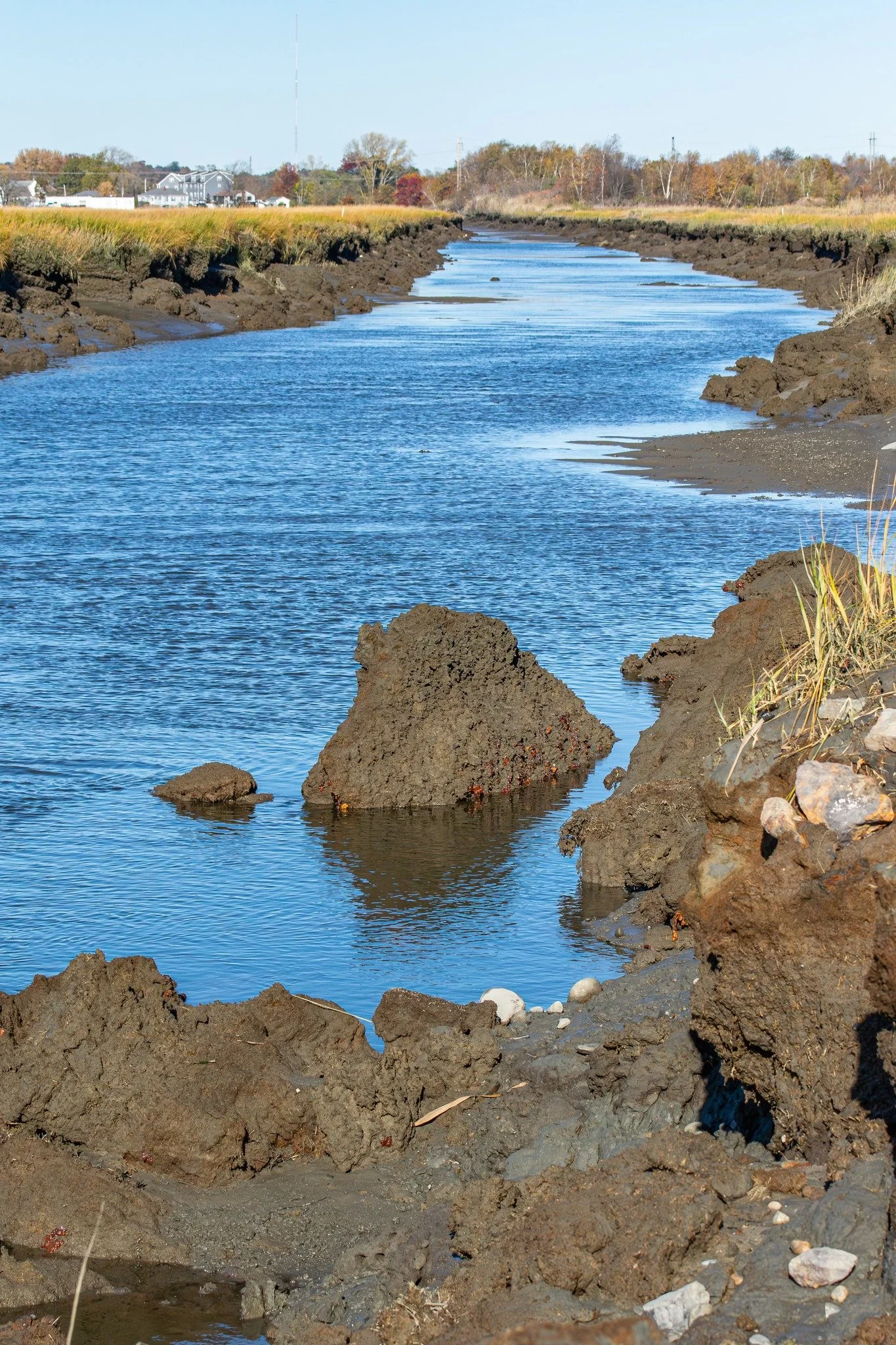
Peat erosion into the former “temporary” channel, now widened by concentrated tidal flow.
The effects of this constraint are visible on the ground.
Alongside the embankment is a linear ditch that was originally cut as a temporary drainage feature during highway construction. It was never intended to function as a permanent part of the marsh. It still does.
Today, that ditch runs parallel to the embankment and serves as a primary pathway for tidal exchange through a single pinch point at the relocated Pines River crossing. With flow constrained to that opening, tides are forced through a narrow corridor and along this ditch with increased velocity.
Over time, the result has been predictable. The ditch has widened and deepened well beyond its original scale. Aerial imagery suggests it has expanded significantly, in some areas approaching the width of the Pines River itself. At that point, it is no longer functioning as a ditch. It is functioning as a channel.
This concentrated flow accelerates erosion along its edges and pulls energy into a system that is already tidally restricted on the west side of the embankment. Instead of distributing water across the marsh platform, flow is being funneled and intensified. It is another expression of the same underlying issue.
The Case for Removal Is Already Made
Its removal is not a novel idea or an untested concept. It is explicitly recognized within the Rumney Marshes ACEC framework, where the embankment corridor was carved out of the designation to allow for its eventual removal. From the outset, the ACEC did not treat the embankment as a permanent feature of the landscape, but as a legacy constraint on a system that otherwise warrants protection and restoration.
“In general, I am, and have been, very concerned with the ultimate fate of this [I-95 embankment] fill. To restate my position, our ultimate goal is to remove the fill and restore the marsh. Any activity which does not further this goal will be deemed inconsistent with the [ACEC] designation.
”
There is also a clear precedent for this type of work. Large-scale fill removal and tidal restoration projects have been carried out across Massachusetts over the past several decades. Efforts tied to Central Artery mitigation, along with coastal restoration and nourishment work in Revere and Winthrop, show that restoring marsh function can be as straightforward as removing historic fill and re-establishing tidal exchange.
As part of historic I-95 embankment fill projects, a remnant berm or ridge was intentionally left in place based on the belief that it provided flood protection. That assumption shaped project design at the time. But the core takeaway still stands: restoring hydrology at scale is not a novel or untested concept. It has been done, and it largely comes down to removing material that should not be there.
It is also worth noting that this material is not without value. Clean fill removed from these sites has been reused in coastal and infrastructure projects, including beach nourishment efforts. That creates a practical pathway for implementation that aligns restoration with broader regional needs.
These are not theoretical exercises. They are implemented projects that demonstrate how correcting historic alterations can restore hydrologic function at meaningful scale.
The scientific basis is equally clear. The EPA’s 2022 Rumney Marsh report evaluated the embankment’s role in the system, including its influence on tidal exchange and flood behavior. Its conclusion was direct: the embankment does not provide meaningful flood protection. What it does do is restrict and distort tidal flow across the marsh, contributing to the very conditions restoration efforts are trying to address, including poor drainage, uneven inundation, and degraded marsh funcion.
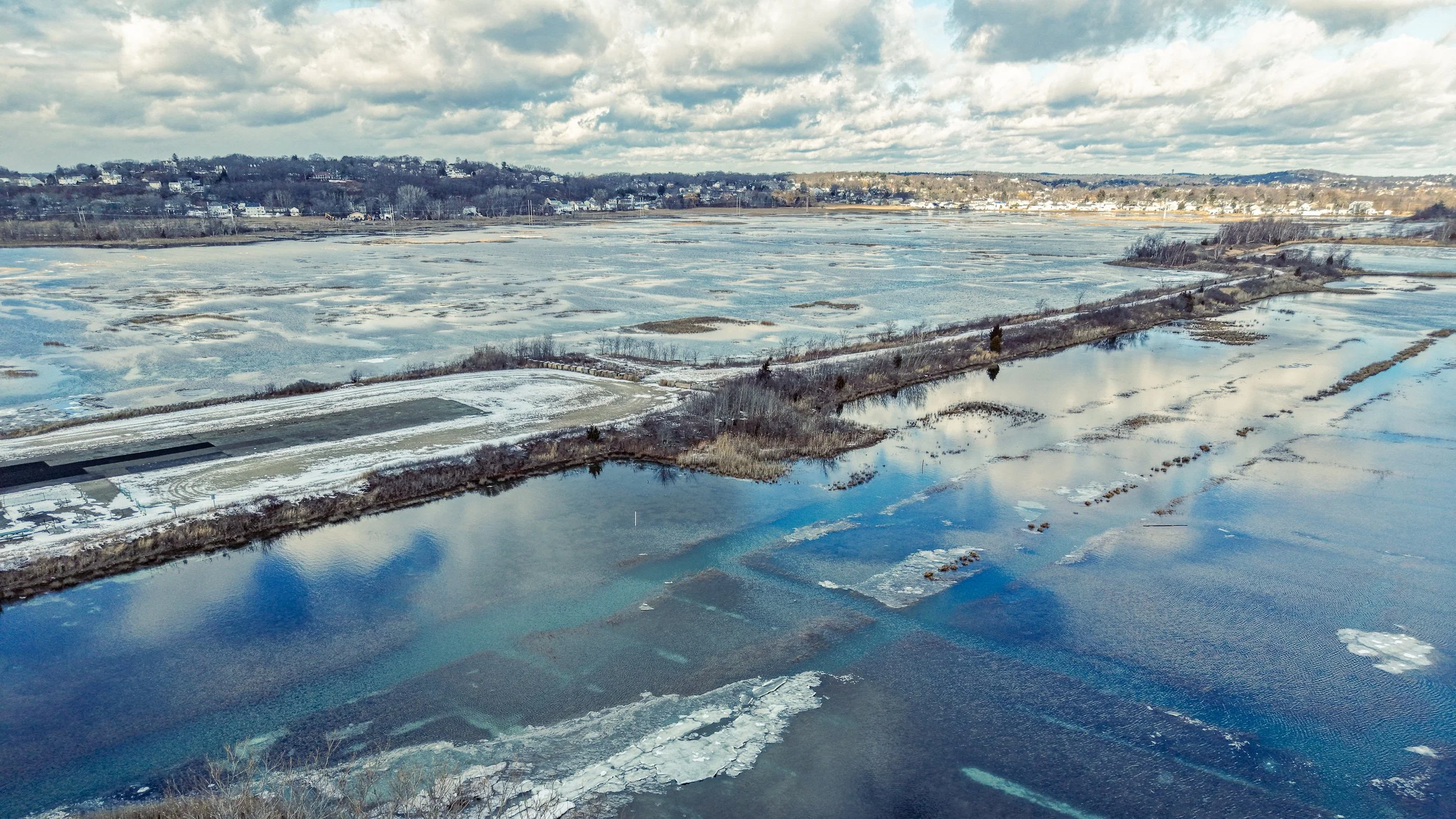
At high tide, the embankment holds no line. Water levels equalize on both sides, underscoring EPA’s conclusion that it offers no meaningful flood protection.
Taken together, the policy framework, built precedent, and technical analysis all point in the same direction. The embankment is not a feature to work around. It is a constraint to remove.
So the question is not whether the embankment matters. It does.
The question is whether there is alignment around acting on that reality.
Aligning Restoration With Reality
This is not an argument against ditch remediation, runnels, or other low-impact techniques. Those tools are important, and they should continue to be used where they make sense. They can stabilize areas, improve habitat, and provide measurable benefits.
But their effectiveness is tied to the larger hydrologic context.
If the goal is long-term restoration at Rumney Marsh, the sequence matters. Work at the surface should be aligned with the underlying hydrology, not separated from it.
Restoration does not have to be either small-scale or large-scale. It should be both. But without restoring tidal flow in a meaningful way, there is a limit to what smaller interventions can achieve.
At Rumney Marsh, restoration is not just about what techniques are used. It is about whether the system itself is allowed to function.
That starts with restoring tidal flow.
