
How a Marsh Became Home to an Ash Landfill
The landfill complex located inside of Rumney Marsh in Saugus, Massachusetts has evolved through several distinct phases over the past seventy years. What exists today as the Saugus Ash Monofill is not the product of a single landfill project, but rather the result of several generations of waste disposal practices layered onto the same landscape.
Understanding this history is important because each phase of development reflects the waste management practices and environmental standards of its time.
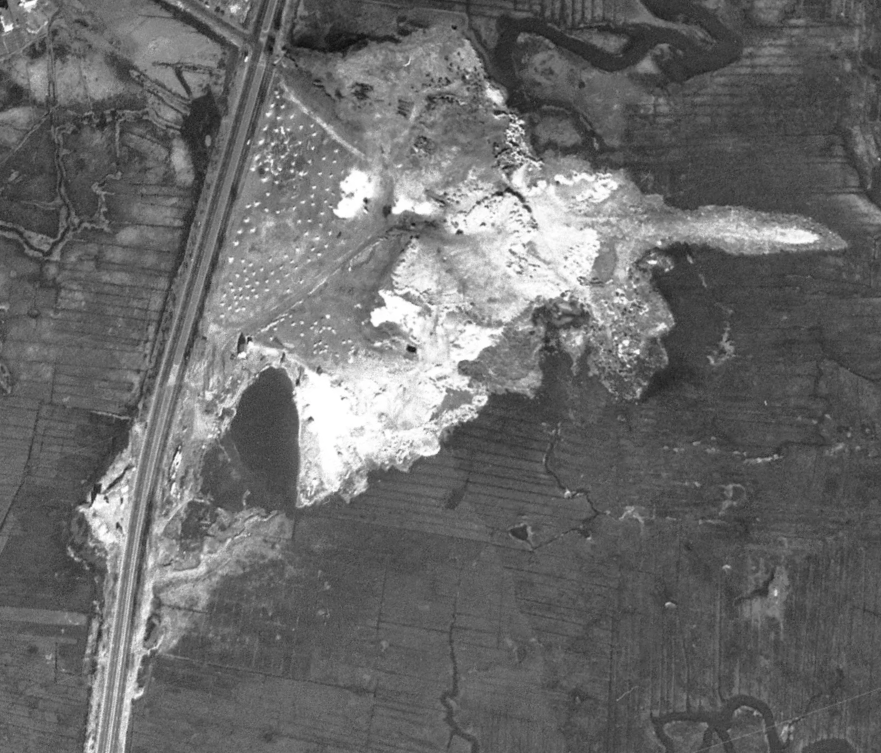
1955 Aerial of Daggett Dump in Saugus, MA
Daggett Dump
The earliest phase of disposal at the site dates to the 1950s, when portions of the area were used as a municipal solid waste dump. At the time, landfills were often established in low-lying areas along marsh edges where filling could raise land elevation. The disposal area became known locally as the Daggett Dump, referring to land associated with Dewey Daggett, who operated or controlled the property during this period. Waste was deposited directly onto the ground surface with little or no containment, which was typical for dumps of that era.
By the mid-1950s, parts of the Rumney Marsh landscape had already begun to change, as evidenced by USGS aerial imagery.
Large stretches of tidal marsh along the Pines River in Revere and Saugus were still open and undeveloped, but certain areas had begun to attract industrial uses. Among them was a tract of marshland owned by Dewey E. Daggett, a local businessman who operated both a wholesale lobster business and a dumping operation nearby.
Daggett’s property included several hundred acres of marsh and upland. Portions of the land were already being used for dumping. At the time, this was not unusual. Before modern environmental regulations, many communities relied on privately owned dumps located in low lying land or marsh areas.
Running both businesses began to take a toll. According to court records, Daggett told his attorney that he could not continue managing the lobster operation and the dumping business at the same time. One of them would have to go.
The decision was made to sell the dump.
A Million Dollar Deal
In early 1957, Daggett authorized his attorney to negotiate a sale of the property. The buyer that emerged was M. DeMatteo Construction Company (“MDCC”), a firm involved in large scale construction and land development in the Boston area.
After several rounds of negotiation, the parties reached an agreement.
On February 7, 1957, Daggett and his wife signed a contract to sell the marshland for $1,000,000, a substantial sum at the time. The agreement included financing terms that would allow the buyer to pay most of the purchase price over time through a mortgage.
For DeMatteo Construction, the land represented an opportunity. The site already functioned as a dump and had the scale and location to support continued commercial disposal operations.
For Daggett, the sale would allow him to step away from the dumping business and focus on the lobster trade.
At least, that was the plan.
Second Thoughts
Within days of signing the agreement, Daggett began to regret the decision.
His attorney soon wrote to DeMatteo Construction proposing that the contract be cancelled. The letter offered to return the deposit and even suggested paying the buyer $10,000 in damages to walk away from the deal.
The buyer declined.
Negotiations continued for several months while Daggett dealt with serious health issues, including severe depression that required psychiatric treatment. During this period both sides effectively paused the transaction while waiting for Daggett to recover.
When discussions resumed, Daggett ultimately refused to proceed with the sale.
DeMatteo Construction responded by filing a lawsuit asking the court to enforce the agreement.
The Court Steps In
The dispute eventually reached the Massachusetts Supreme Judicial Court in the case M. DeMatteo Construction Co. v. Daggett.
Daggett’s defense rested on two arguments. First, he claimed the buyer had failed to properly complete the closing on the scheduled date. Second, he argued that his mental health at the time of signing had impaired his judgment.
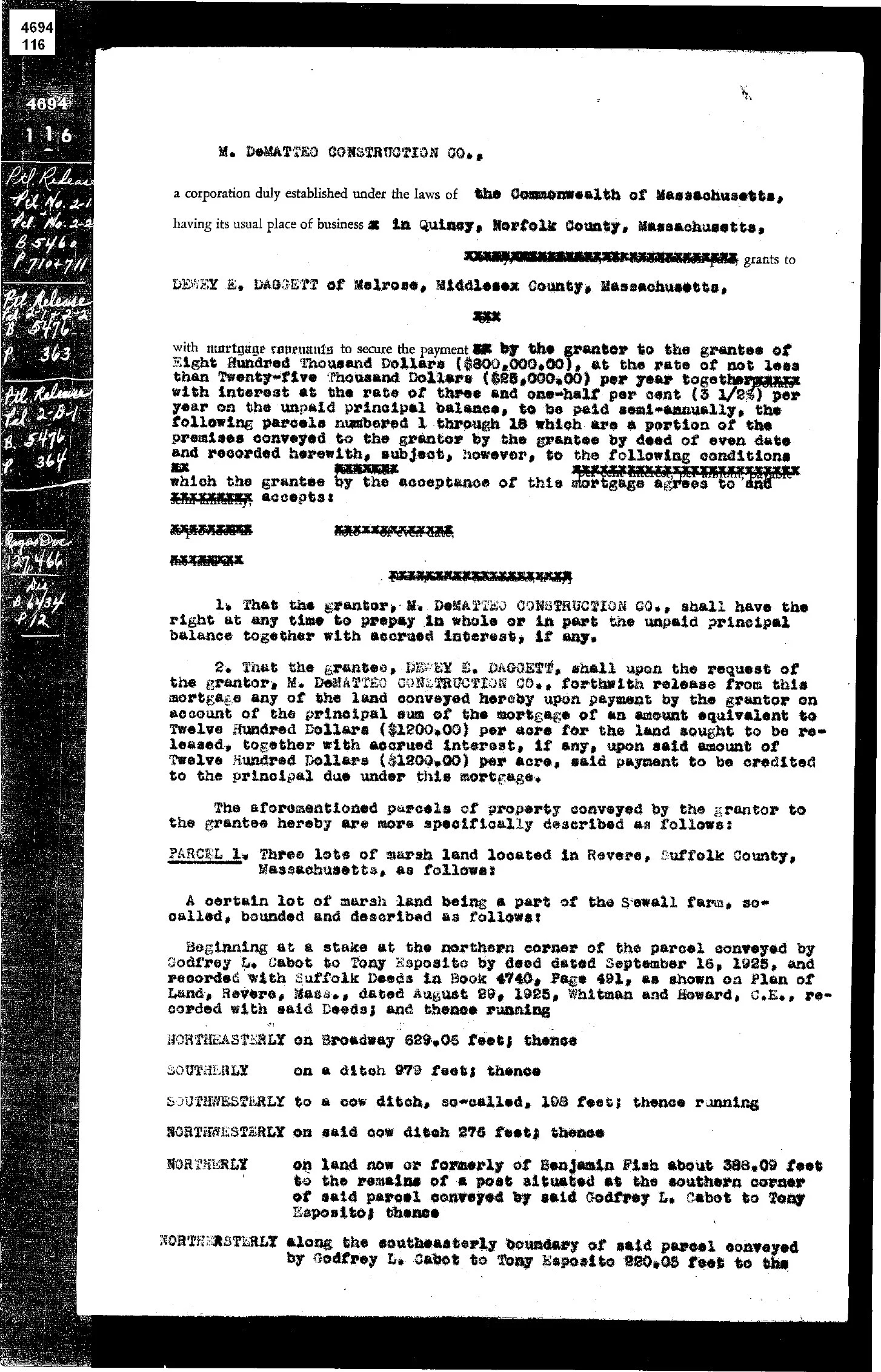
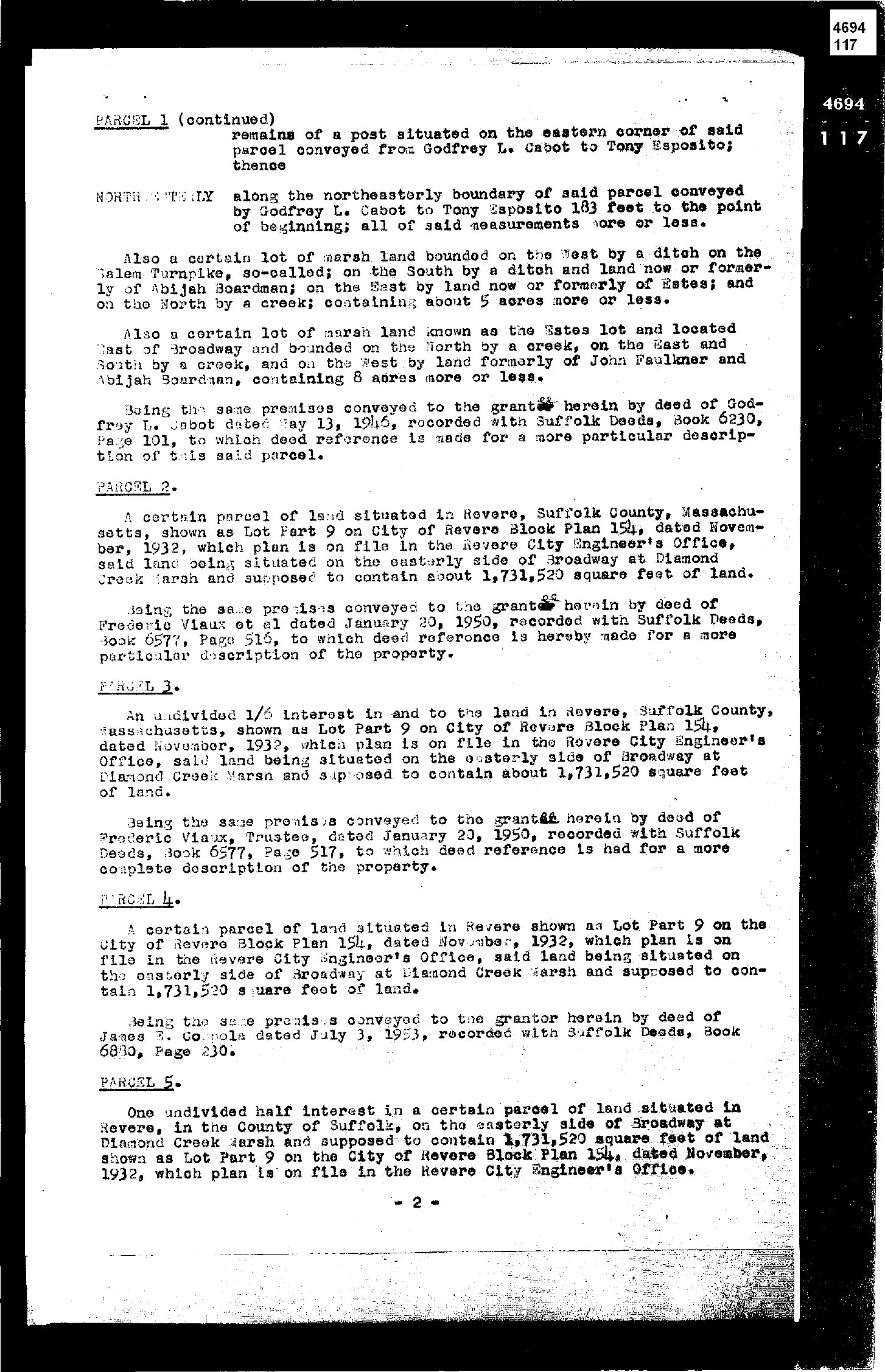
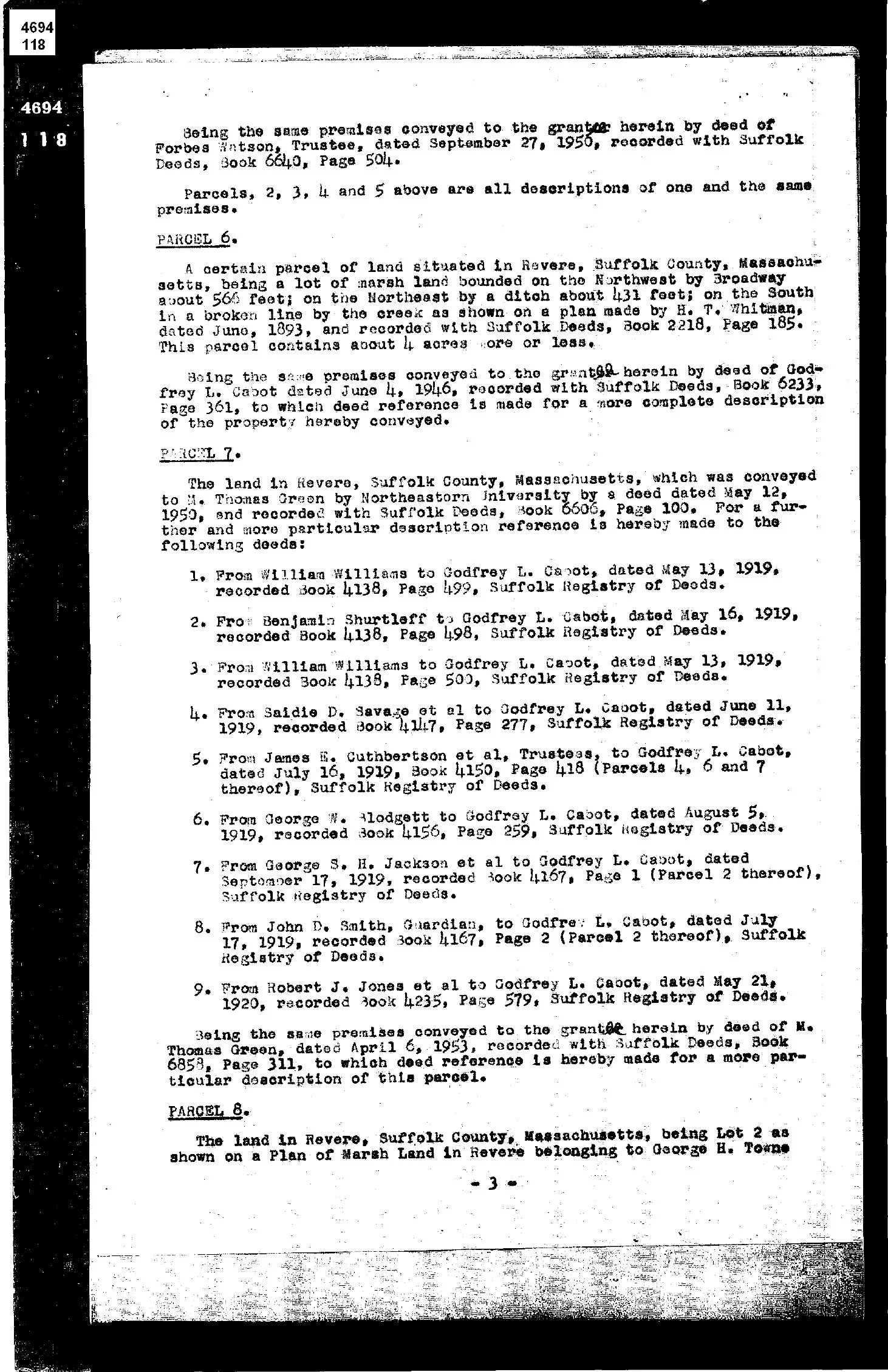
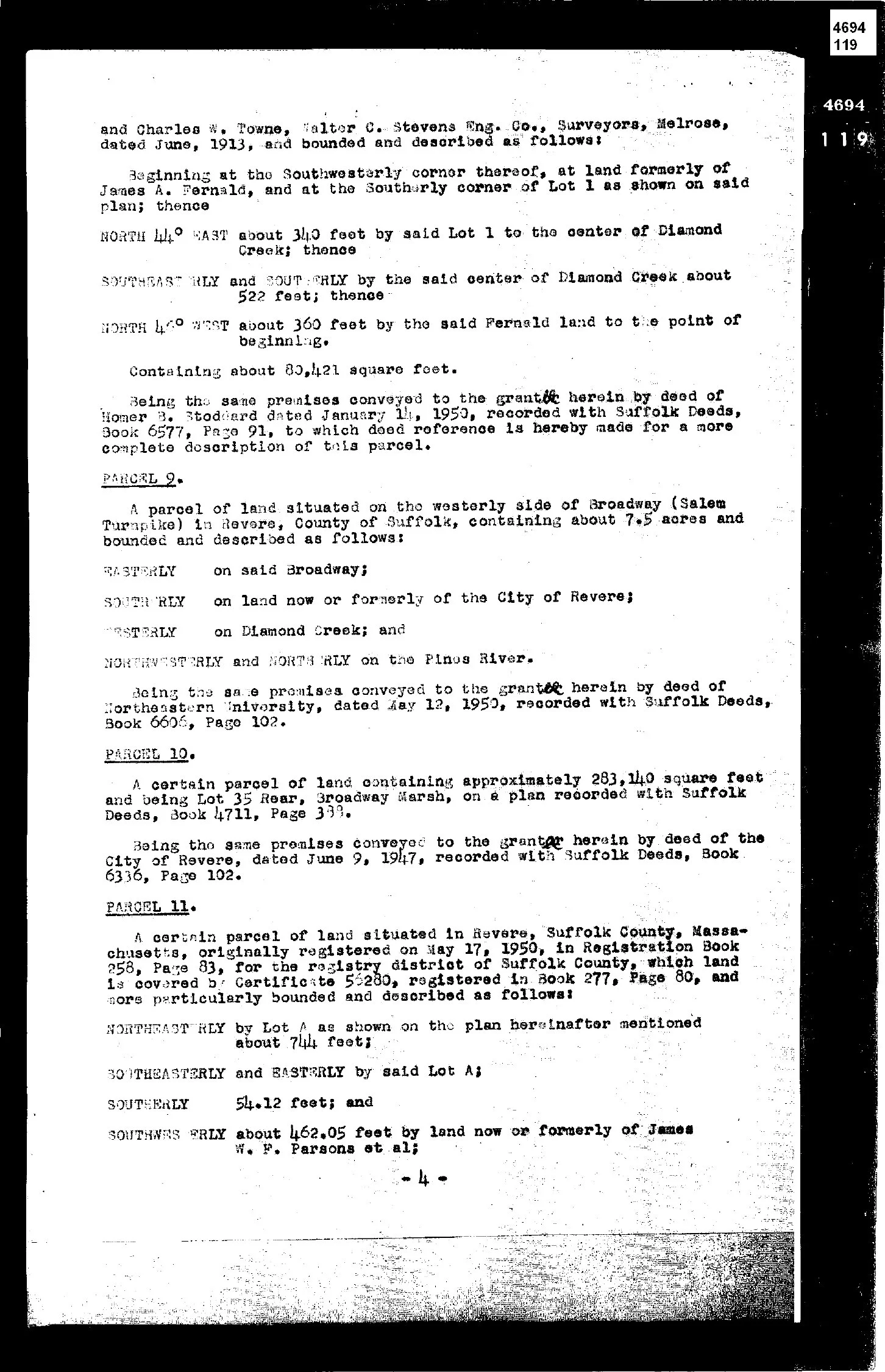
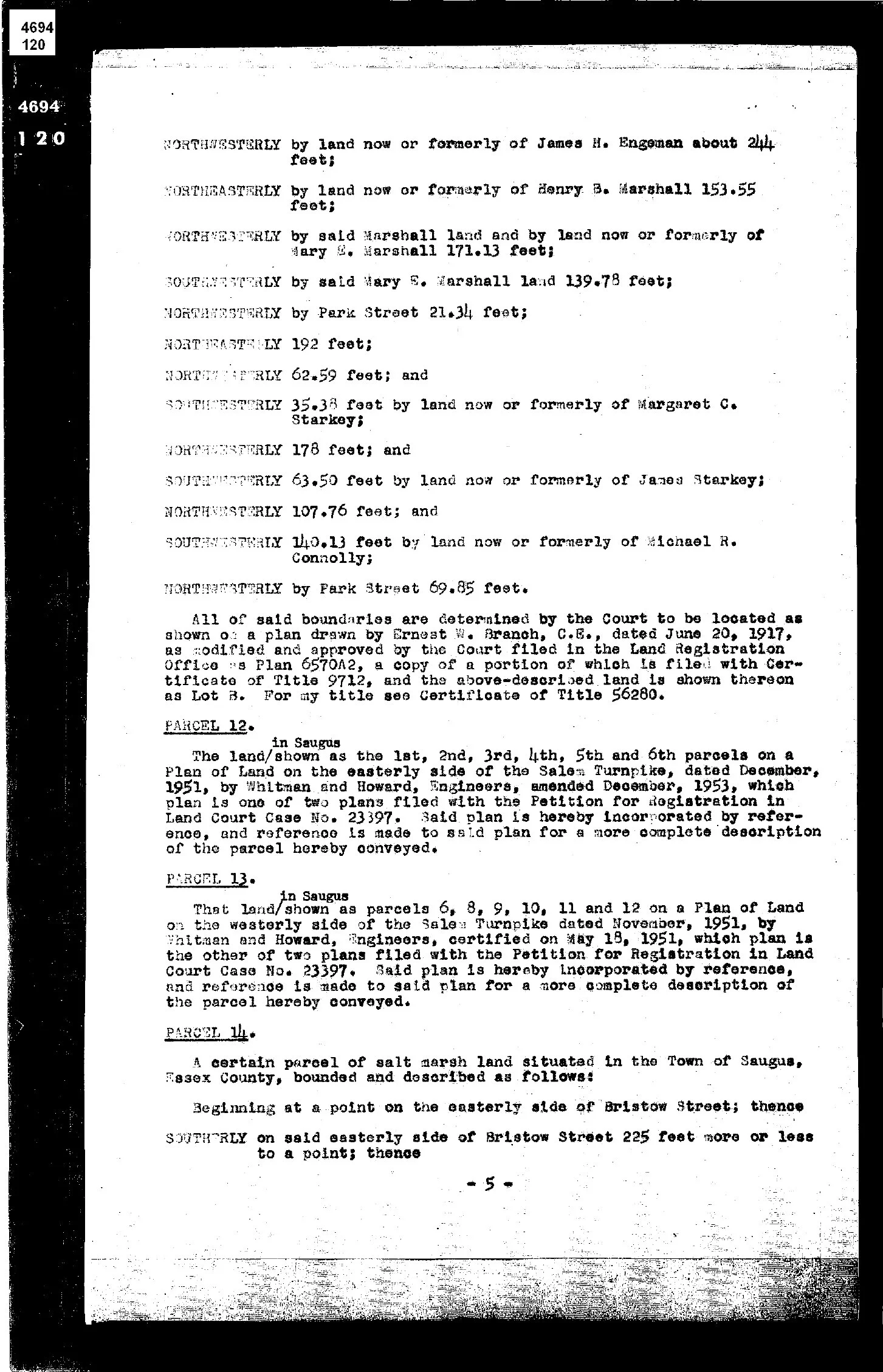
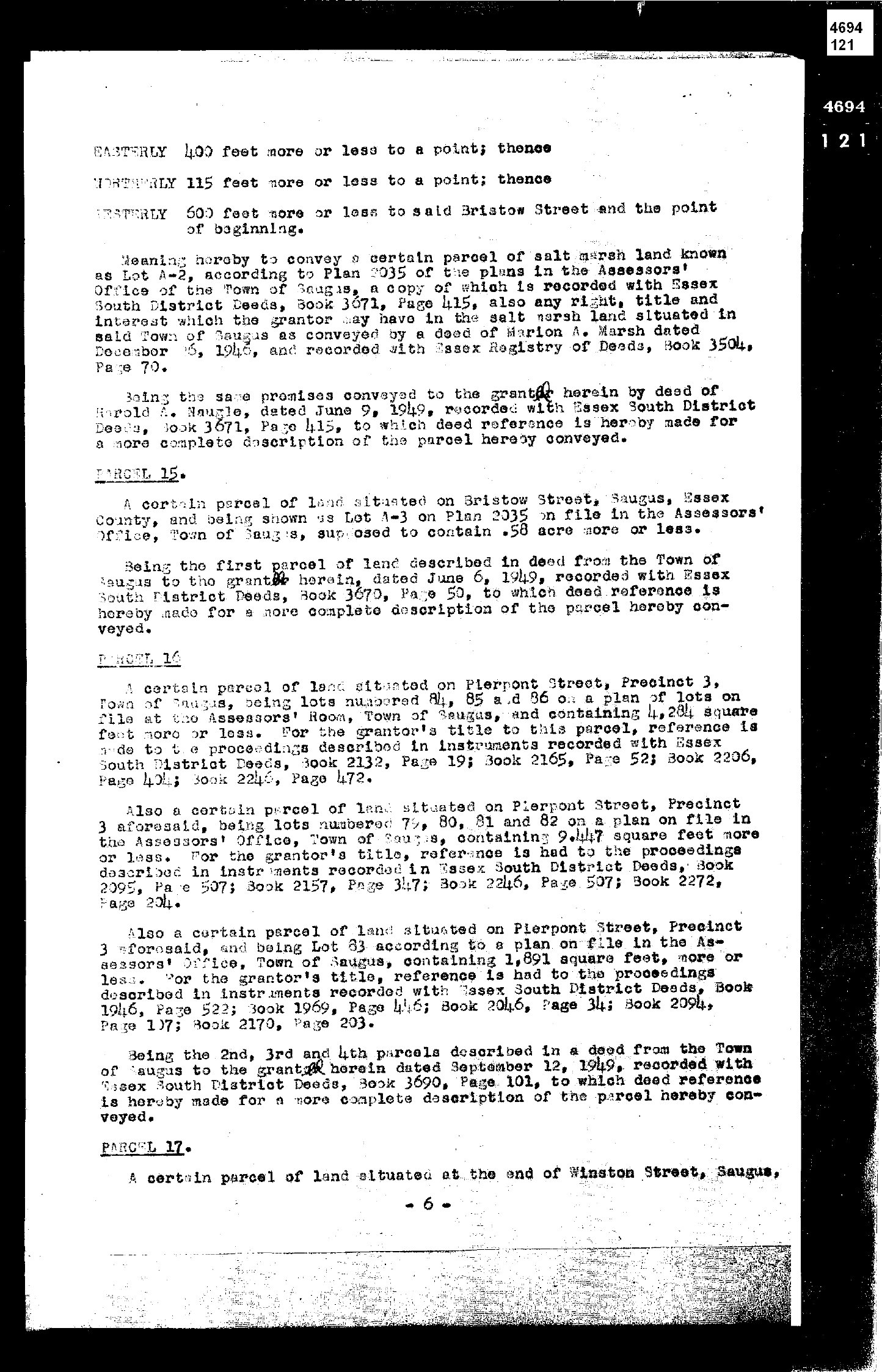
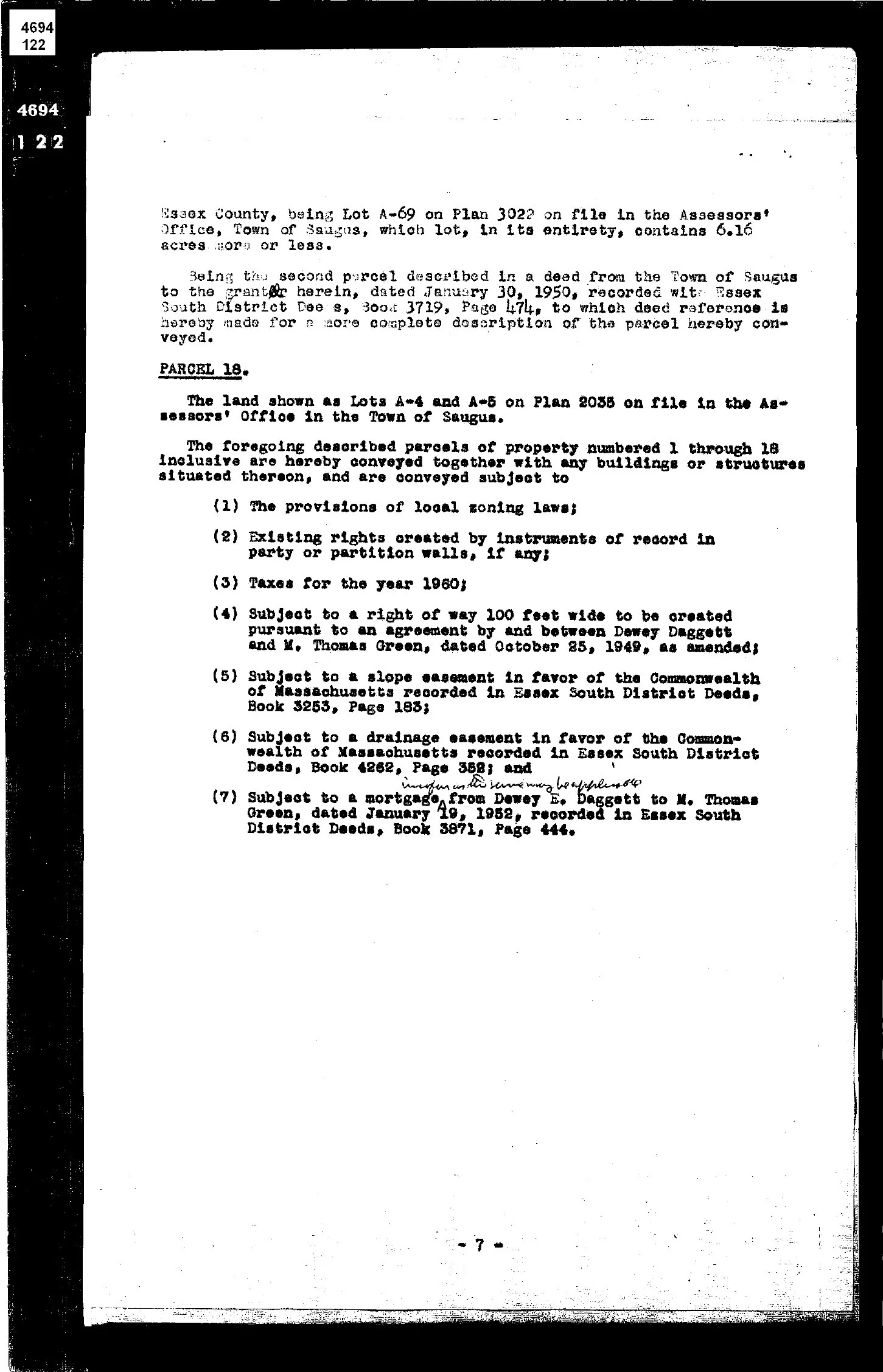
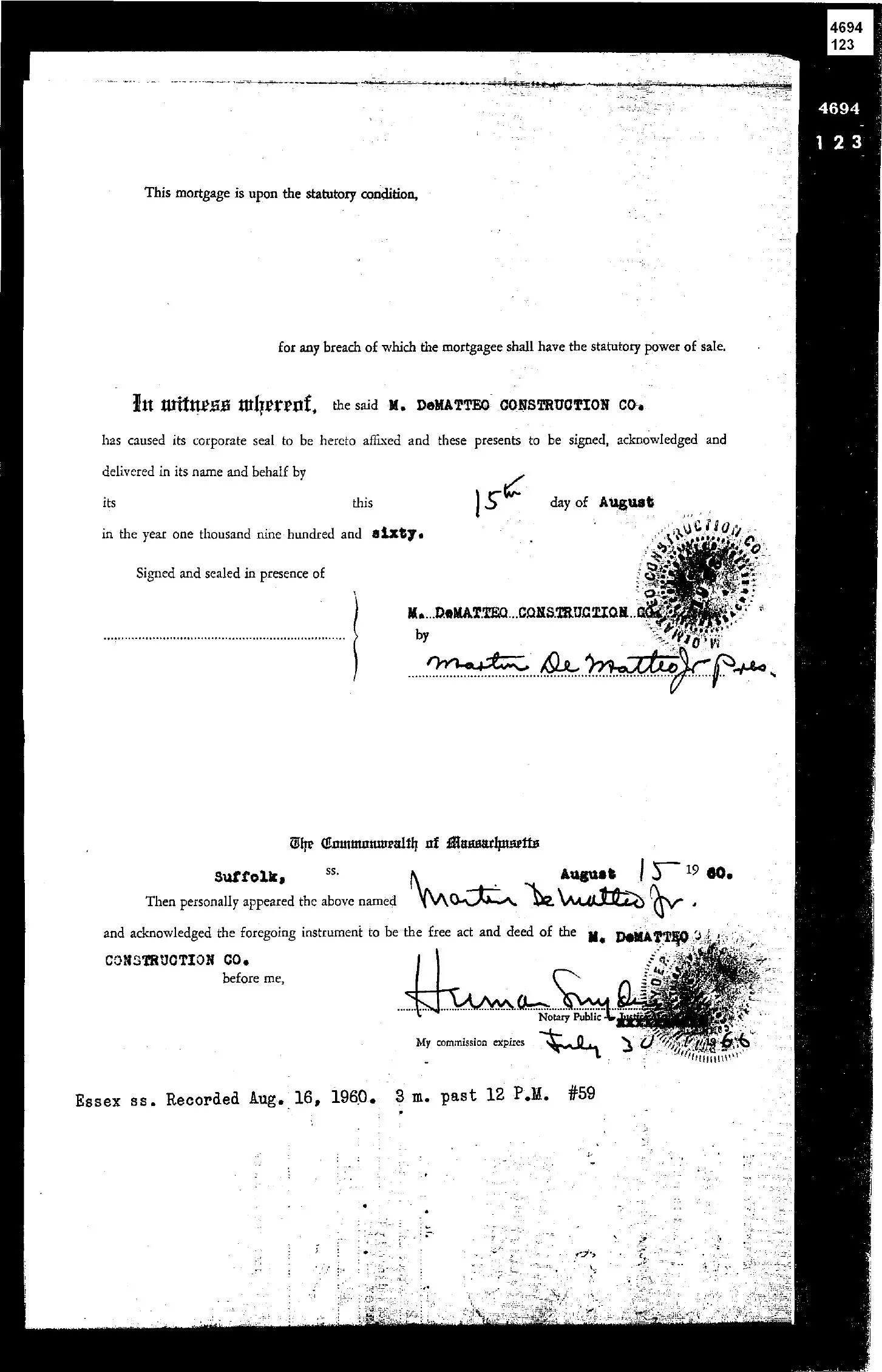
The court rejected both claims.
The justices found that Daggett had actively negotiated the transaction, discussed taxes and financing details with his attorney, and reviewed the agreement before signing it. While he was experiencing depression, the evidence showed that he understood the nature of the deal.
The court also ruled that the buyer was not required to formally tender performance on the closing date because Daggett had already made clear that he did not intend to go through with the sale.
In 1960, the court ordered specific performance, meaning the contract had to be carried out.
The marshland would be sold.
A New Chapter for the Marsh
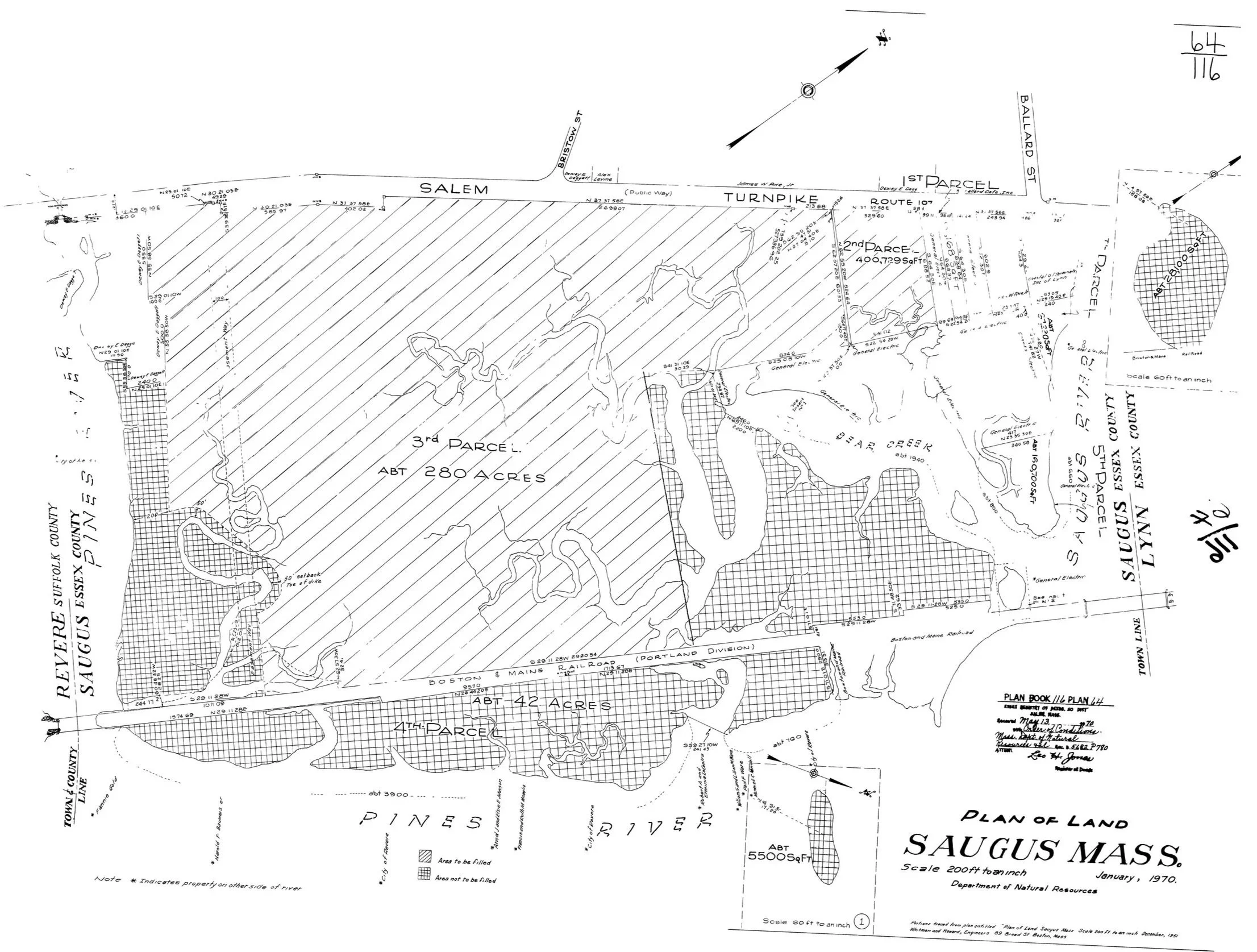
1970 plan showing land owned by M. DeMatteo Construction Company in Saugus
The plan was incorporated into a January 1970 Order of Conditions issued by the Massachusetts Department of Natural Resources under G.L. Chapter 130, Section 27A, which regulated dredging and filling of coastal marsh areas prior to the Massachusetts Wetlands Protection Act. The permit limited where marsh filling could occur and required the work to follow the areas shown on this plan.
Source: Southern Essex District Registry of Deeds, Plan Book 116, Page 64. Permit recorded at Book 5682, Page 780.
The ruling confirmed that M. DeMatteo Construction Company would take ownership of the property.
What had begun as a privately operated marsh dump under Dewey Daggett now entered a different phase. Under DeMatteo’s control, the site continued to operate as a commercial dumping area, part of a growing pattern of waste disposal moving into the low lying marshlands along the Pines River.
At the time, these activities were still relatively small in scale. Marshland dumps, construction debris, and municipal refuse were common features in coastal landscapes throughout the region. But the conditions that made the site attractive for dumping were about to intersect with something much larger.
Across Massachusetts and the country, the postwar waste stream was growing rapidly. Communities were beginning to search for new ways to manage increasing volumes of trash, and large scale waste infrastructure was starting to emerge.
Within the next two decades, the land that Daggett once owned and nearly refused to sell would become part of a far more ambitious project. The era of small private dumps would give way to a regional system built around a waste to energy incinerator.
That project would eventually be known as RESCO.
The Next Big Idea
Through the 1960s and early 1970s, the landfill continued to expand as waste volumes increased across the Boston metropolitan region. Disposal occurred along the margins of the Rumney Marsh ecosystem and the Pines River. Environmental regulation was still limited during this era, and open dumping remained common throughout much of Massachusetts.
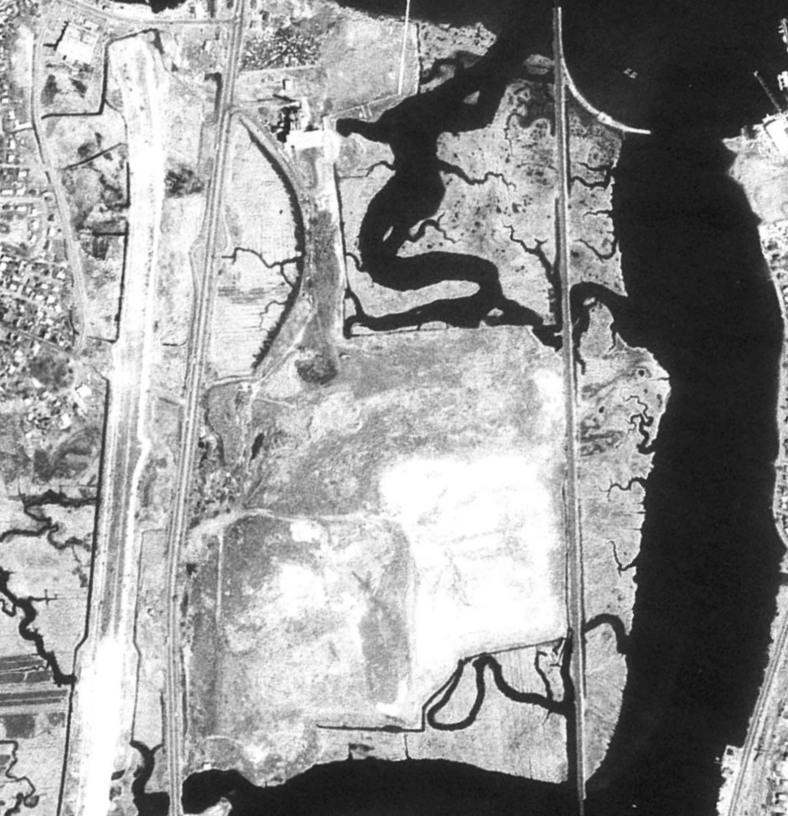
1977 Aerial Imagery showing RESCO incinerator and further expansion of the Saugus landfill.
By the late 1970s, regional waste policy began shifting toward a new approach. Faced with growing volumes of municipal solid waste and limited landfill capacity, planners increasingly turned to waste-to-energy incineration as a way to reduce the volume of trash requiring disposal. Municipalities across eastern Massachusetts began planning a large regional facility that would burn municipal waste while generating electricity.
That facility was ultimately constructed in Saugus by the Refuse Energy Systems Company (RESCO).
The RESCO Saugus waste-to-energy plant began operating in the 1970s and quickly became one of the region’s primary waste processing facilities. While incineration dramatically reduces the volume of municipal waste, it does not eliminate it entirely. Combustion produces large quantities of ash that must still be disposed of in a landfill.
To accommodate this new waste stream, ash from the incinerator was placed in the existing landfill adjacent to the facility. What is now known as the Saugus Ash Monofill developed gradually, as incinerator ash was deposited on top of earlier municipal solid waste from the region’s mid-century dumping era.
This layering matters because the landfill was never built as a modern lined facility designed solely for ash disposal.
From Dump to Engineered Landfill
By the late 1980s, regulators began requiring a more formal engineering framework for the site. In 1989, the landfill received its first comprehensive Engineering Report and Closure/Post-Closure Plan. A Final Engineering Plan (FEP) followed in 1990, outlining landfill operations, closure design, environmental monitoring requirements, and long term maintenance obligations. These plans were developed under a regulatory consent order with the Massachusetts Department of Environmental Protection.
During the early 1990s, major containment infrastructure was installed. This included a perimeter slurry wall, stormwater management systems, and engineered landfill cover systems intended to isolate the waste mass from surrounding groundwater and wetlands.
Large portions of the landfill were capped in phases during the 1990s and early 2000s. Despite these closure activities, the facility continued receiving ash from the incinerator. As disposal capacity gradually diminished, the operator sought regulatory approvals to extend the landfill’s operational life. Revisions to the Final Engineering Plan were approved in 1997 and again in 2008, allowing additional capacity and modifications to the final cover system.
The most recent major revision occurred in 2017, when regulators approved a permit modification allowing additional ash placement in two existing depressions within the landfill known as Valley 1 and Valley 2. These areas are currently being filled and capped as part of the landfill’s final configuration.
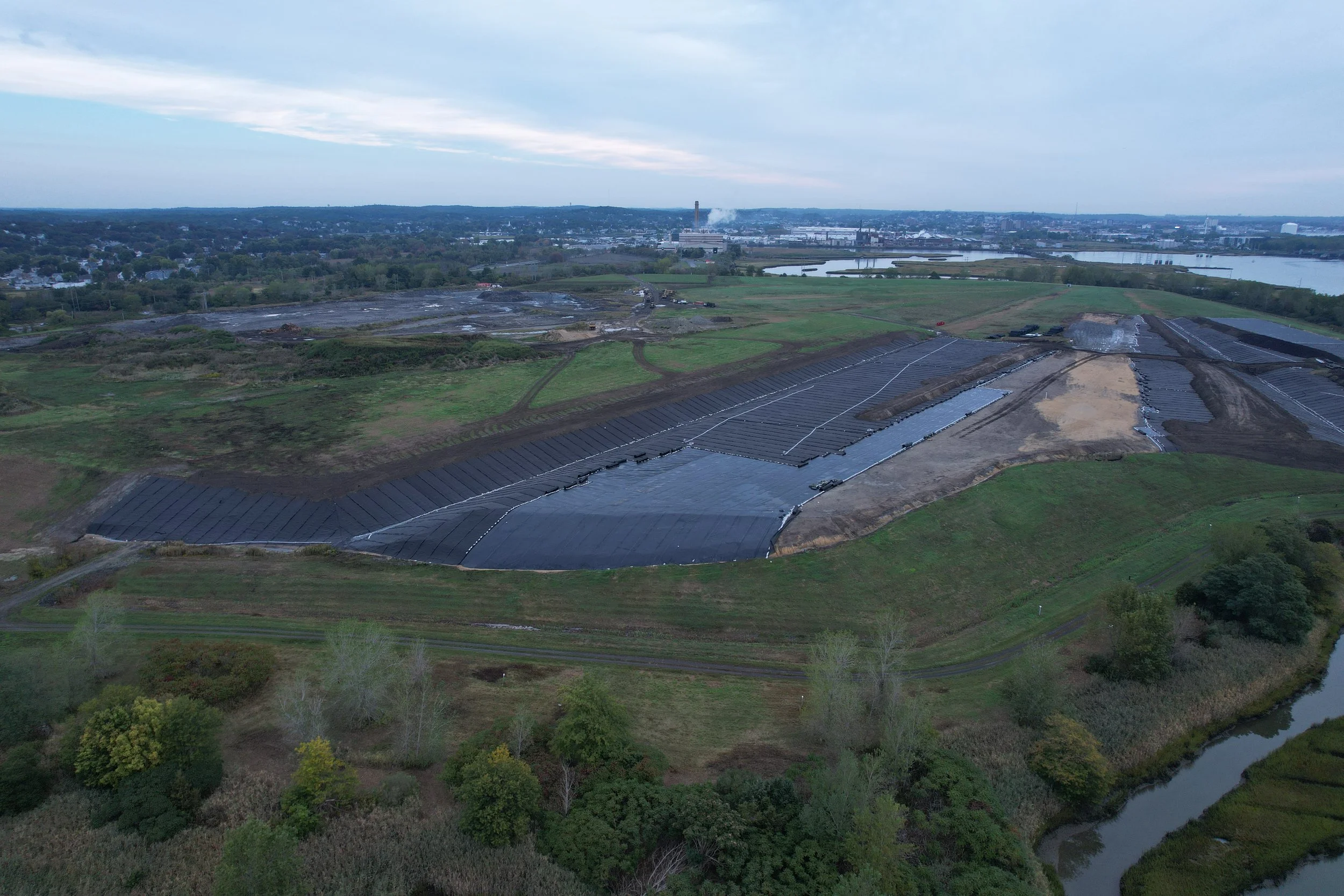
Saugus Ash Monofill, 2025 - capping in progress
Buying Time
The most recent chapter of the Saugus Ash Monofill story is still being written.
In 2017, regulators approved a modification to the landfill’s Final Engineering Plan allowing additional ash to be placed in two remaining depressions within the landfill known as Valley 1 and Valley 2. The approval allowed the operator to regrade and fill these areas as part of the landfill’s final configuration.
That valley fill project has now been completed.
As of 2026, the landfill remains in operation but is approaching its permitted capacity. In order to extend the remaining life of the facility, the incinerator is now shipping roughly 75 percent of its ash offsite for disposal. The strategy slows the rate at which the monofill fills, effectively stretching the remaining capacity.
It buys time. Buying time, however, is not the same as defining a closure plan.
At a March 2026 meeting of the Saugus Board of Health, the Ash Landfill Closure Committee asked the Board to take a more structured role in monitoring the timeline for closure of the site, which sits within the Rumney Marshes Area of Critical Environmental Concern (ACEC).
Committee members reviewed several key regulatory milestones governing the landfill’s future.
MassDEP’s approval allowing ash staging and transport from the site was issued on November 1st, 2017, with a ten year term that expires on November 1st, 2027.
The landfill’s Revised Final Engineering Plan also establishes a maximum elevation of 50 feet above mean sea level. Any proposal to exceed that height would require a new site assignment from the Saugus Board of Health.
Correspondence from both the Baker and Healey administrations has indicated that the site does not meet regulatory site suitability criteria for expansion.
An October 2025 annual report prepared by Brown & Caldwell projected the remaining life of the monofill at roughly 0.4 to 1.5 years, depending largely on how much ash continues to be transported offsite.
The landfill itself has been characterized by MassDEP as unlined.
In response, the Board of Health voted to place Ash Landfill Closure Updates as a standing agenda item for future meetings and invited the operator’s engineers to present updated projections and closure planning documents.
For residents and environmental advocates following the issue, the timeline is no longer theoretical. Permits have expiration dates. Engineering plans have height limits. Disposal capacity is finite.
More than half a century after Dewey Daggett nearly backed out of selling his marshland dump, the same landscape now sits at another turning point.
Local communities wait for the long promised closure of the landfill. At the same time, many are watching closely for what the next proposal might be.
Will the protections of the Rumney Marsh ACEC prove sufficient to guide the site toward closure?
Or will the region’s waste system once again find a way to extend the life of the landfill?
For now, the clock continues to run.
